

Why “safe settings” exist at all
Facebook’s anti-spam system doesn’t read your post and decide if it’s spam. It watches how you post — the timing patterns, the content variation, the IP, the session, the behavior. Two accounts can post the exact same text to the exact same groups and one gets flagged, one doesn’t, based purely on pacing and variation.
Safe settings = behavioral patterns that look indistinguishable from a real user.
The four levers
There are four settings that matter, in order of importance:
1. Delay between posts (most important)
The single biggest signal Facebook uses to detect automation is regularity. If you post every 30.0 seconds for an hour, you are obviously a bot — humans never type that consistently.
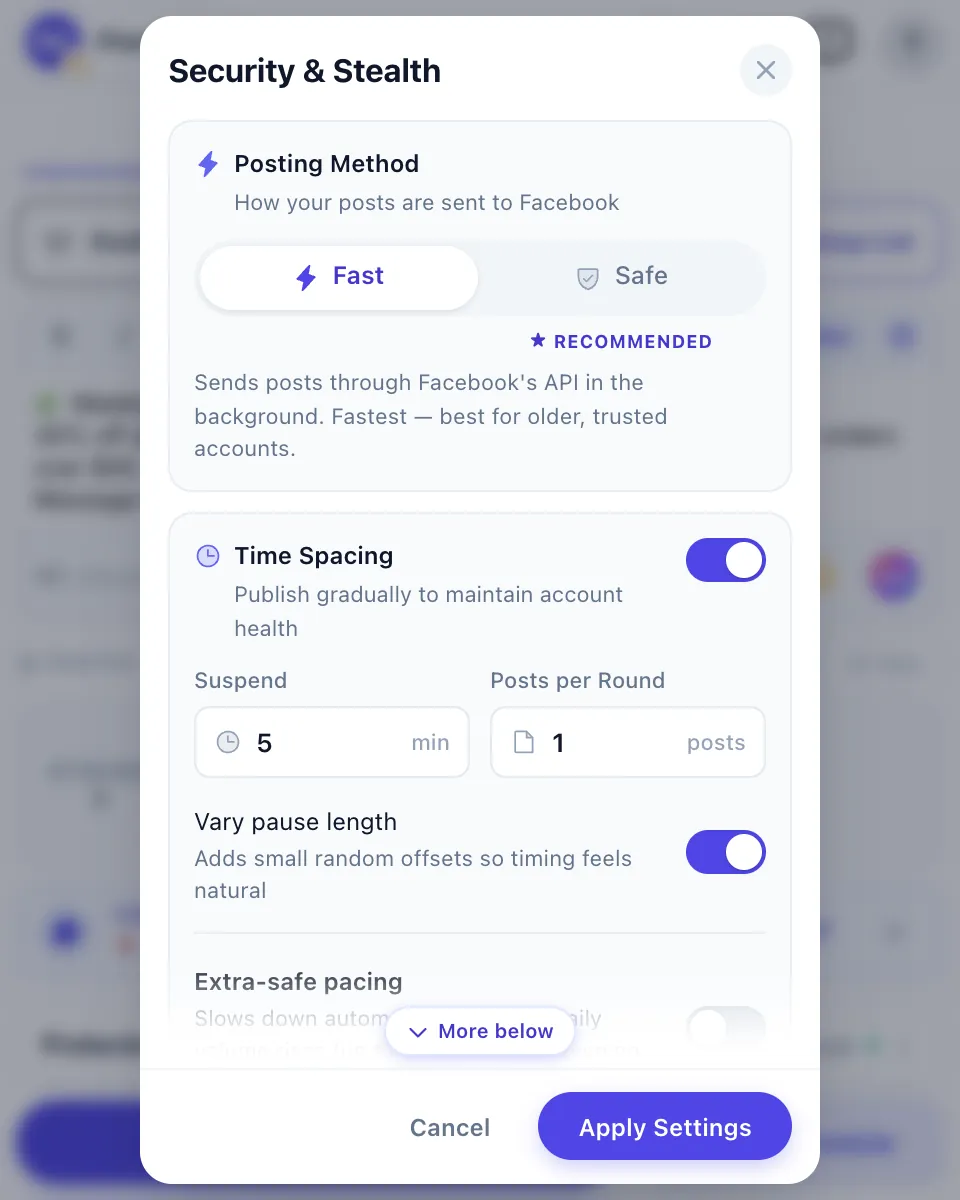
Recommended: keep MultiGroupPoster’s default pacing. It pauses for roughly 3–6 minutes after every 1–3 posts (a new random count each time) and makes the pauses longer as the day’s post count grows. If you set your own rhythm with Time Spacing, allow at least 3 minutes between posts — more on runs over 60 groups — and leave Vary pause length on. The randomization is what matters: 3 min 10 s, 5 min 40 s, 4 min 5 s — that’s a human. 3:00, 3:00, 3:00 — that’s a bot.
2. Daily volume
| Account age | Conservative | Standard | Aggressive |
|---|---|---|---|
| Under 6 months | 10–20 | 20–40 | 40+ (risky) |
| 6–12 months | 20–40 | 40–80 | 80+ |
| 12+ months | 40–80 | 50–100 | 150+ (some users do 200–300) |
Over 200 posts/day on any account, randomly verify your posts are still landing. Facebook sometimes silently downranks instead of explicitly flagging.
3. Content variation (Spintax)
Identical text in 20+ groups within a few hours triggers duplicate-content detection. Spintax is the fix: write your post once with {Hi|Hey|Hello} syntax, and the engine serves a different version to each group.

Minimum: 3 alternatives in 3 places = 27 unique combinations per template.
{Hi|Hey|Hello} folks! Just dropped {a new|the latest} guide on
{X|Y|Z}. {Check it out|Take a look|Have a read}: example.com
4. Media attachment
Text-only posts at high volume get flagged more than posts with images or videos. Even a generic stock image lowers your detection probability.
Bonus: posts with images get 2-3× more engagement, which is itself a positive signal that pushes Facebook’s algorithm toward giving you more reach.
What to avoid
These behaviors trigger flags faster than anything else:
- Constant timing (same delay every post).
- Identical text across multiple groups.
- High velocity (50+ posts in 10 minutes).
- Multiple Facebook accounts posting from the same browser session within an hour.
- Same external link in 30+ posts (especially short URLs like bit.ly).
- Cloud auto posters that publish from data-center IPs at full speed.
- Brand-new accounts posting at experienced-account volumes.
Templates that work
Here are three Spintax templates that real users in real estate, e-commerce, and recruiting have run reliably. Adjust to your niche.
Real estate listing
{Just listed|New listing|Just on the market}: {a stunning|a beautiful|a gorgeous}
{3-bedroom|family home|fixer-upper} in {Tampa|St. Pete|Sarasota}.

{Move-in ready|Fully renovated|Priced to sell}.

{DM me|Reply|Comment INFO} for {a tour|the full details|photos}. 🏡
Variations: 3 × 3 × 3 × 3 × 3 × 3 = 729 unique posts.
E-commerce buy/sell
{Selling|Available|For sale}: {brand-new|barely-used|like-new} {item} for ${price}.

{DM if interested|Reply to claim|Comment SOLD if you want it}.
{Pickup in {city}|Local pickup only|Shipping available}.
Recruiting / job opening
{Hiring|Now hiring|Open role}: {role} at {company}.
{Remote|Hybrid|In-office} · {salary range}.

{Apply via the link|Drop your resume in the comments|DM me directly}: {link}
Putting it together
A safe campaign looks like this:
- Pick 50–80 groups (already organized into a saved list).
- Compose with a Spintax template that has 3+ alternatives per phrase.
- Attach an image or video.
- Keep the default pacing — or, with Time Spacing on, at least 3 minutes between posts with Vary pause length on.
- Click post. With 50–80 groups the run takes several hours in the background; the pauses are the point.
- Don’t post again in those groups for 24–48 hours.
Run that pattern daily, and your account stays in the green for years.
FAQ
What are the safest auto poster settings to start with?
For an account older than twelve months: 50–100 posts a day, randomized pauses of a few minutes between posts, Spintax on with at least three alternatives per phrase, an image attached, and the run spread over four to eight hours rather than compressed into one.
Should the delay between posts be fixed or randomized?
Always randomized. A constant gap is one of the clearest automation signals available, and it is visible no matter how slow you set it. Posts exactly five minutes apart, over and over, look more automated than gaps of three, six and four minutes.
How should settings change for a newer account?
Scale down with age, as in the table above: under six months, stay around 20–40 posts a day, roughly half an established account’s limits; six to twelve months, 40–80. A brand-new account should first warm up with about thirty days of normal personal activity before any bulk posting.
Do I need to change settings after a restriction?
Yes. Returning to the same pace that triggered the limit will usually trigger it again. Resume at roughly half the previous volume with longer delays and keep it there for a couple of weeks before edging back up.
Building a safe-by-default campaign? MultiGroupPoster ships these settings as defaults and warns you when you push past them.