

What “restricted” actually means on Facebook
When marketers say “I got restricted”, they usually mean one of five things, in order of severity:
- Soft pacing warning — “You’re posting too fast.” Posts still go through, but the warning is a yellow card.
- Feature limit — Facebook blocks a specific feature (commenting, posting to groups, sending messages) for 24h–7d. Posts to groups silently fail.
- Reach throttling — your posts publish but get dramatically reduced reach. Hard to detect because there’s no notification.
- Group post block — you lose the ability to post in groups specifically. Lasts 1–30 days depending on history.
- Account suspension — full account restriction. You can log in but can’t do anything. Usually the result of repeat strikes.
Most marketers who “got banned” were actually at level 2-3 and could have recovered with a 48-hour timeout. Pushing through a level-2 warning is what escalates to level 4-5.
The community’s name for these restrictions is “Facebook jail”; how to avoid Facebook jail breaks down the triggers and how long each one lasts.
The six rules
Rule 1 — Randomize delays
A bot has constant intervals. A human doesn’t. Facebook’s automation detection watches for regular timing.
Rule: delays between posts must vary. 3 min 10 s, 5 min 40 s, 4 min 5 s, 2 min 50 s — that’s a human. 3:00, 3:00, 3:00, 3:00 — that’s a bot.
In MultiGroupPoster, this is the default: it pauses for roughly 3–6 minutes after every 1–3 posts, a new random count each time. In other tools, find the “randomize delays” toggle and confirm it’s on.
Rule 2 — Vary your content
The duplicate-content heuristic looks for paragraphs that repeat verbatim across groups. The fix is Spintax: write once with {Hi|Hey|Hello} syntax, serve different versions to each group.
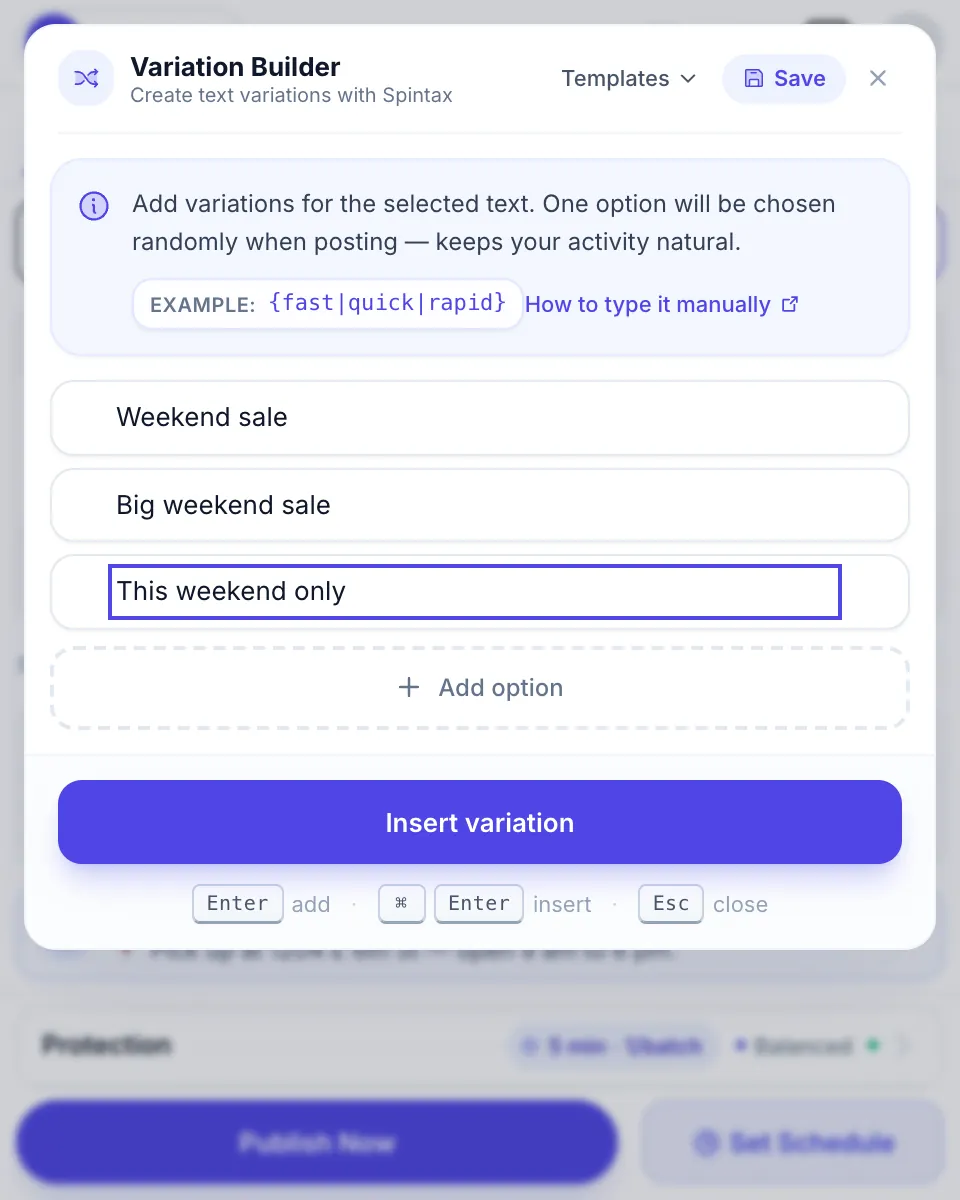
Minimum: 3 alternatives in 3 places = 27 unique combinations. Better: 5 alternatives in 4 places = 625 combinations.
Rule 3 — Account age matters
| Account age | Max safe daily volume |
|---|---|
| 0–30 days | Don’t bulk post. Use only manually. |
| 30–90 days | 10–20/day. |
| 3–6 months | 20–40/day. |
| 6–12 months | 40–80/day. |
| 12+ months | 50–100/day standard, 150–200 with care. |
Brand-new accounts attempting 100/day on day 5 get suspended with near-certainty.
Rule 4 — Attach media
Text-only posts at high volume get filtered more aggressively. Even a stock image lowers your flag rate noticeably.
Bonus: image/video posts get 2-3× more engagement, which Facebook reads as a positive signal that increases reach.
Rule 5 — Spread across hours
100 posts in 30 minutes flags. 100 posts spread across 6 hours doesn’t. The pattern Facebook watches for is sustained high-velocity posting.

Best practice: plan posting windows. “9–11 AM, 1–3 PM, 5–7 PM” with breaks between.
Rule 6 — Warm new accounts
A fresh Facebook account has no “trust” signal. You build trust by:
- Friending real people who friend you back.
- Posting personal content (photos, status updates) for 2–3 weeks.
- Joining groups gradually, not 50 at once.
- Engaging in groups (commenting, liking) before posting in them.
- Slowly introducing posting volume — 5/day, then 10, then 20, week by week.
After 30 days of normal usage, the account is “warm” enough to start moderate posting. Skipping this gets new accounts suspended within hours.
What to do if you trip a warning
- Stop posting immediately. Don’t try to “just finish today’s batch” — that’s how you escalate from warning to block.
- Log out of all sessions except your main one.
- Take a 24–48 hour total break. Zero posting, zero commenting, zero new group joins.
- Resume at 50% of your normal daily volume. Post 25/day for a week, then ramp back to your usual pace.
- Check facebook.com/support/your-violations for any explicit notices.
What not to do:
- Don’t switch to a VPN. That makes it worse.
- Don’t post from a different browser/device immediately. Facebook tracks devices.
- Don’t appeal the warning unless you have a clear reason — automated appeals usually get auto-rejected and add a strike.
Cloud tools vs browser extensions
For groups, this isn’t really a comparison — it’s a wall. Cloud tools post through Meta’s official API, and that API lost the publish_to_groups permission on 22 April 2024. No cloud scheduler can reach a Facebook group any more, regardless of settings or IP. A browser extension running in your own logged-in session is the only architecture that still works.
Within browser extensions, the setting that matters most is how aggressively you configure it: safe defaults (randomized pacing, Spintax variation, realistic daily volume) carry materially less risk than pushing speed and volume past what a careful person would do by hand. We don’t have a controlled study to put exact numbers on that gap — what we have is the operational guidance in this article, which reflects what we recommend and ship as defaults.
Account portfolio strategy (advanced)
Some marketers run multiple Facebook accounts to spread risk:
- 1 primary account for personal use (always safe).
- 2–3 secondary accounts for posting, each on its own browser profile.
- Different IP for each account if possible (separate phones, separate office connections, not a VPN).
This is allowed but Facebook’s account-linking detection is sophisticated. Mixing accounts on the same browser session usually gets all of them flagged together. If you go this route, use Chrome profiles religiously.
FAQ
What actually triggers a Facebook posting restriction?
Patterns, not raw volume. The signals that matter most are identical text across groups, a constant interval between posts, text-only posts at high volume, and a sudden burst of activity from an account with little recent history.
How long do posting restrictions usually last?
Most are temporary rate limits measured in hours or a few days, not permanent bans. The correct response is to stop posting, resume at a much lower volume, and leave the pacing settings lower afterwards rather than returning to the previous rate.
Does attaching an image really reduce the risk?
Yes, meaningfully. Text-only posts at high volume are treated more aggressively than posts with media, and images also give you a second dimension to vary — rotating the image across groups matters as much as rotating the text.
Is warming up a new account worth the delay?
For an account under six months old it is the difference between working and being restricted in the first week. Thirty days of ordinary personal posting, commenting and joining a few groups at a human pace costs a month and prevents a much longer problem.
Looking for an auto poster that ships safe defaults out of the box? MultiGroupPoster does exactly that — the defaults match the rules in this guide.