

Posting to Facebook groups is one of the last places on the platform where an unpaid post can still reach a real, engaged audience. But it’s also where people get their accounts restricted the fastest — usually not because they posted too much, but because they posted like a machine. These nine best practices are the difference between generating leads for years and getting flagged in a week.
1. Keep a 70/30 value-to-promotion ratio
The single most important habit: contribute value at least twice as often as you promote. Answer questions, share tips, join conversations — then, occasionally and only where it’s allowed, promote. Admins remove obvious self-promoters, and Facebook throttles promo-heavy accounts, so leading with value is what earns you the right to promote at all. The full breakdown is in the 70/30 rule.

2. Post at the right time
A great post published at the wrong time reaches no one. Group activity clusters around early morning, the lunch break, and the evening in the audience’s timezone. Posting into an active window gets you early comments, and early comments are what push a post further. See the best times to post in Facebook groups for the windows by niche.
3. Open with a question
Facebook redistributes group posts that generate comments. The easiest way to earn comments is to open with a genuine question your audience wants to answer. A post that starts a conversation reaches far more members than one that just makes a statement — and it builds your reputation at the same time.
4. Put links in the first comment
Many groups auto-delete posts that contain a link in the body, and Facebook tends to reduce the reach of posts that push people off-platform. The fix marketers rely on: keep the post body clean and link-free, then drop your link as the first comment. The post stays native, keeps its reach, and survives the admins. Here’s how first-comment links work.
5. Vary your text and images
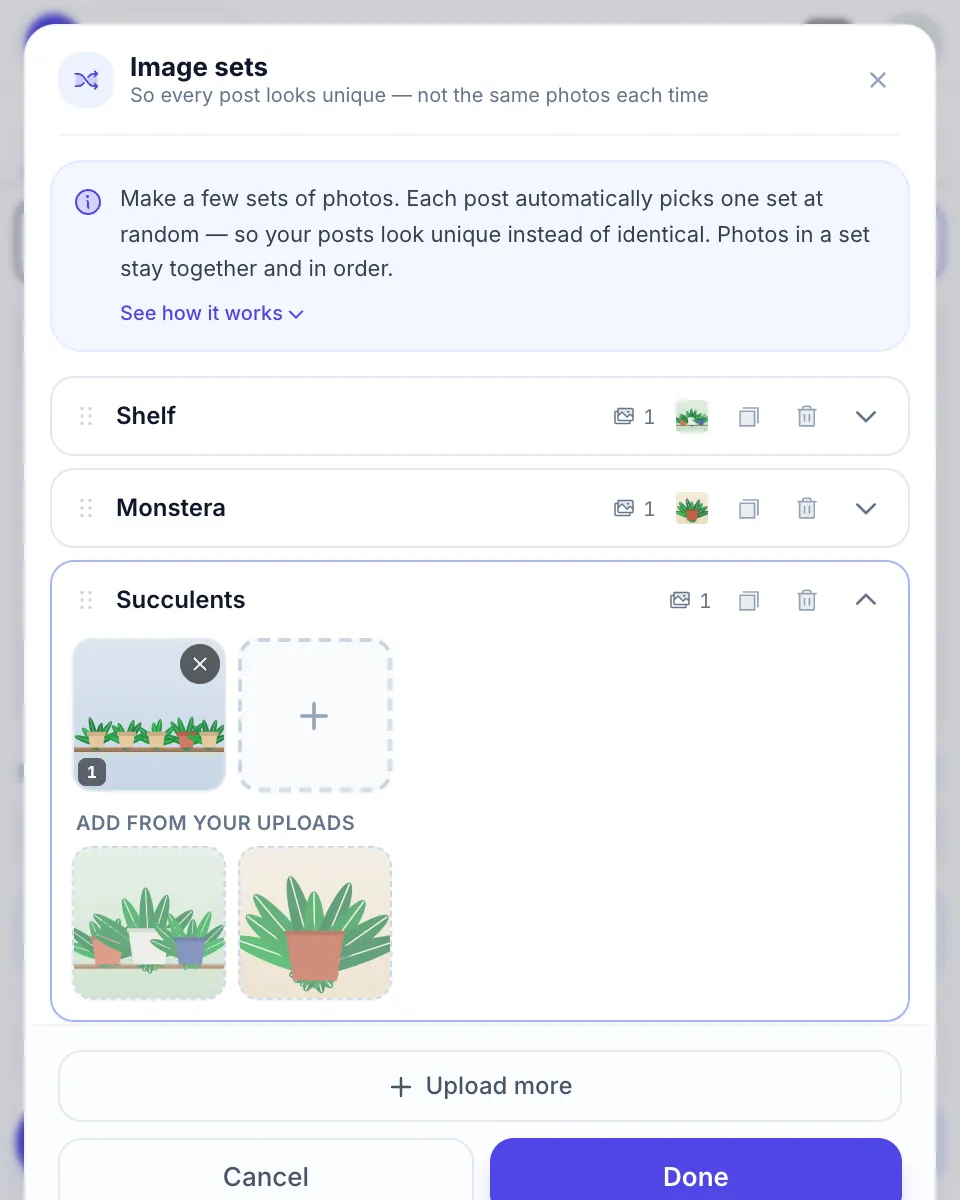
Posting the identical text — and the identical image file — into many groups is the number-one duplicate-content signal Facebook watches for. Vary both: use Spintax to spin the text so each group gets a different wording, and rotate between different image sets so the photos differ too. See the Spintax guide and how to vary images across groups. This isn’t a trick to fool a filter — it’s genuinely being varied, which is what a real person does anyway.
6. Respect each group’s rules
Every group has its own pinned rules, and breaking one is the fastest way to get removed by an admin. Some groups ban links, some require a flair, some only allow promotion on a specific day. Read the rules before you post, and keep a separate list of the groups that actually allow promotion so your offers only go where they’re welcome.
The full guide to reading and working within those rules is Facebook group promotion rules.
7. Space posts out
Firing ten posts in the same minute is the clearest bot signal there is. Space your posts out with randomized delays and spread them across hours rather than minutes, so the sequence looks like a person working through their groups — not a script. This is exactly the kind of pacing a posting tool automates, so you don’t have to sit and time each one.
8. Warm up new accounts
A brand-new or freshly-reactivated account has little trust, so it gets restricted faster. Before any bulk posting, spend a few weeks completing the profile, joining a few relevant groups, and engaging normally — then ramp up gradually. Full routine in account warming.
9. Track what works and double down
After you post, look at which posts actually published and which groups silently rejected them, drop the dead groups, and repeat what performs. You don’t need per-group analytics for this — a simple post success/failure list is enough to prune your list over time and focus on the groups that convert.
Where a tool fits
Most of these practices are habits you can do by hand — but doing them consistently across dozens of groups every day is the hard part. That’s the mechanical half a tool handles: MultiGroupPoster runs inside your own logged-in Chrome session (it never stores your password), posts to the groups you’re a member of, varies each post with Spintax and rotating Image Sets, drops your link into the first comment automatically, and paces the batch with randomized Time Spacing and a Natural Presence setting so it looks human. You still write posts worth reading and follow each group’s rules — the tool just handles the repetition.
FAQ
What are the most important Facebook group posting best practices?
Lead with value (roughly a 70/30 value-to-promotion ratio), post at peak times, open with a question, put links in the first comment, vary your text and images so posts aren’t identical, follow each group’s rules, space posts out with randomized delays, warm up new accounts, and track which posts land. Together these generate leads without tripping Facebook’s spam detection.
How often should I post to Facebook groups?
Consistency beats volume. A steady daily or near-daily presence — a few well-varied posts spaced across the day — outperforms a big batch once a week. On established accounts, 50-100 posts/day across many groups is common with proper pacing; new accounts should stay much lower until they’re warmed up.
How do I post to Facebook groups without getting banned?
No tool can guarantee you’ll never be restricted, but you dramatically reduce the risk by pacing posts (randomized delays), varying every post with Spintax and different images, keeping links in the first comment, following group rules, and staying within sensible daily limits for your account age. Facebook flags robotic patterns, not participation.
Should I put links in the post or the first comment?
The first comment. Many groups auto-delete posts with links in the body, and Facebook tends to reduce the reach of posts that send people off-platform. Keeping the body link-free and dropping the link as the first comment keeps the post native and its reach intact.
Do these best practices still work in 2026?
Yes. They’re built on how Facebook’s spam and ranking systems are widely observed to behave — rewarding varied, engaging, human-paced participation and demoting identical, robotic, link-heavy blasting. The specifics (like first-comment links) are low-risk habits that keep working regardless of algorithm tweaks.
Follow these nine and posting to groups stops being a game of dodging restrictions and becomes a reliable, compounding lead source. Give value, vary everything, pace like a human, and keep the groups that work.
Try it free: MultiGroupPoster — free tier, no credit card.